
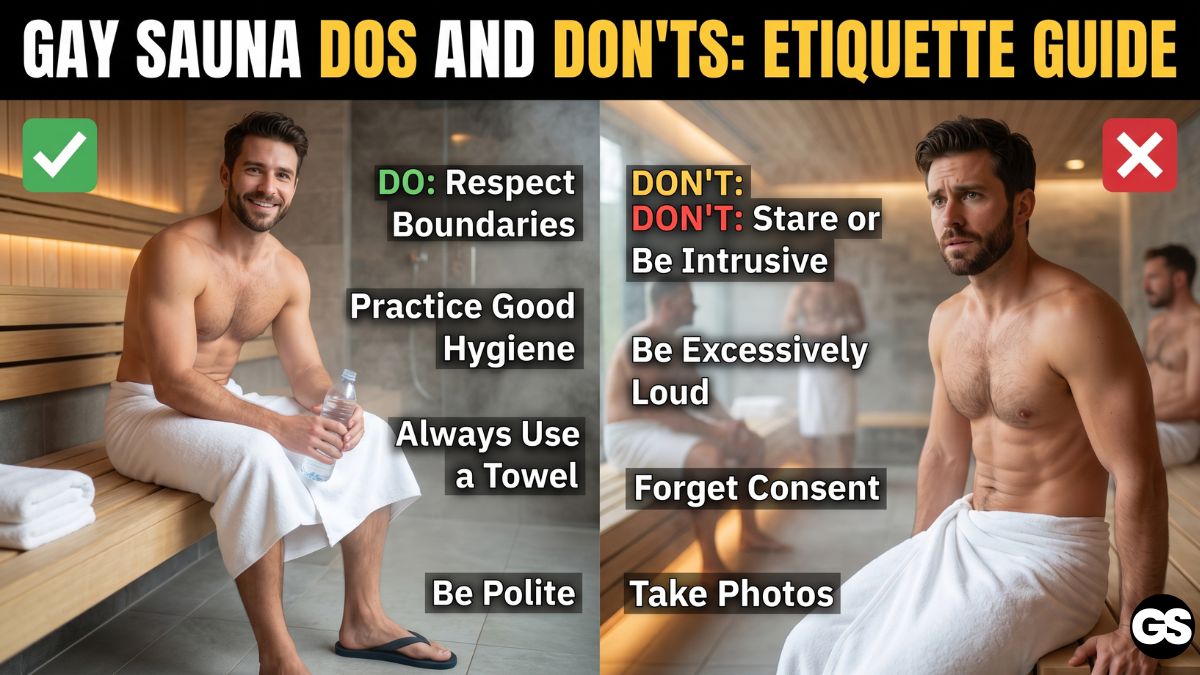
Most of what happens in a sauna happens without anyone speaking, which is why consent in here looks different from consent in a bar. The rules are the same — yes is yes, no is no, you can change your mind — but the language is mostly silent. Read this once and you'll have it.
No is a complete sentence
If you only take one thing from this page, take this: no is the whole answer. You don't owe anyone a reason, an apology, or the longer version. A man worth your time doesn't need the reason; a man who needs the reason isn't worth your time.
That goes for spoken nos and silent ones, in cabins and out of them, the first time he asks and the fifth. Nothing about this place obliges you to explain yourself, and the regulars know it.
How an encounter actually starts
A consenting encounter in a sauna usually has three quiet steps, and reading them is most of the skill. The look comes first — eyes that hold for longer than passing, then come back, then come back again. Then proximity — drifting closer in the steam room, leaving a cabin door open, sitting where you can be seen.
Touch is the third step and it's the question itself. A hand on a shoulder, the small of a back, a forearm — brief and light, the kind of thing easy for either of you to back out of. The whole sequence is a slow yes, and either of you can step out of it at any point.
If you skip a step — touch before the look, proximity before the eye contact — you're asking out of order, and most men will read that as a no by default.
How no looks when nobody's saying anything
Most nos in a sauna are non-verbal because most of the conversation is. The list of moves is short, and every regular reads it the same way.
A shake of the head; a hand on his hand to move it; a step back; walking away; closing the cabin door; turning to face the wall in the steam room. Any one of those is a full answer, and that's how it gets read.
If you do any of those and the other guy keeps going, the problem is him, not your delivery. The signals are clear; men who pretend they aren't are pretending.
How yes looks
Yes in a sauna is just as quiet, and it's the mirror image of no. A look that holds and comes back. Leaning in instead of away, an open cabin door, a hand that stays where you put it.
Touch is what turns a glance into a question. If he leans into it or doesn't move, the answer is yes; if he shifts away or moves your hand, the answer is no, and the next move is yours — to step back, not to try again.
There's more on the open-door / closed-door grammar on the dos and don'ts page, and a room-by-room guide to the rooms those signals happen in on the inside page.
You can say yes and then say no
Saying yes at the start does not lock you in. You can be ten seconds in or ten minutes in and decide you're done, and stopping is always allowed.
The change of mind doesn't need to be explained. The same small set of moves works — pulling back, standing up, closing the door, walking out. He'll read it the same way he'd have read it earlier.
A man worth being in a cabin with respects the change as readily as he respected the start. If he doesn't, you walk, and you flag it to staff on the way past.
What isn't consent
A few things look like consent in a sauna and aren't. Worth naming each one, because the bloke who pretends not to know the difference is the bloke this page exists to head off.
- A dropped towel.
- Being naked.
- Being in the darkroom.
- Sitting close to him in the steam room.
- Showing up at all.
None of those is a yes. Consent is a yes — verbal or in the body — to the specific thing that's about to happen. Anything short of that, you read as a no.
What to do when someone won't take the hint
If a man won't take a no, find staff. They're at work and this is part of the work — they don't need a long explanation, and they aren't going to make you justify it.
"He's not taking no" is the whole sentence. "Uncomfortable in the steam room" is the whole sentence. Either is enough, said quietly at the desk.
Most men read a no the first time; the small number who don't are exactly what staff are there for. You don't lose face by asking — every man at the desk has handled this before, and the regulars steer around the same names you would.
How to read a no without taking it personally
Reading a no in here is its own small skill, and the trick is not turning it into a story. He looked away. He shut the door.
That's the whole content of the message. He isn't rejecting you as a person — he isn't interested in this, right now, with you, in this room. There's a thousand quiet reasons that have nothing to do with you, and you don't need to know any of them.
Take the no, take it lightly, and carry on. A man who reads a no easily is a man other men want to be in a cabin with — and that, more than anything else, is how the second look comes back.
The whole page in one breath
No is a sentence; the body says it more often than the mouth. A held look is yes, a look that flicks away is no, and touch asks the question light enough to back away from. You can change your mind, a dropped towel is not a yes, and anyone who won't take the hint is staff's job — they're glad to do it.
Read it once, carry it lightly, and you'll never have to think about any of it on the floor.