
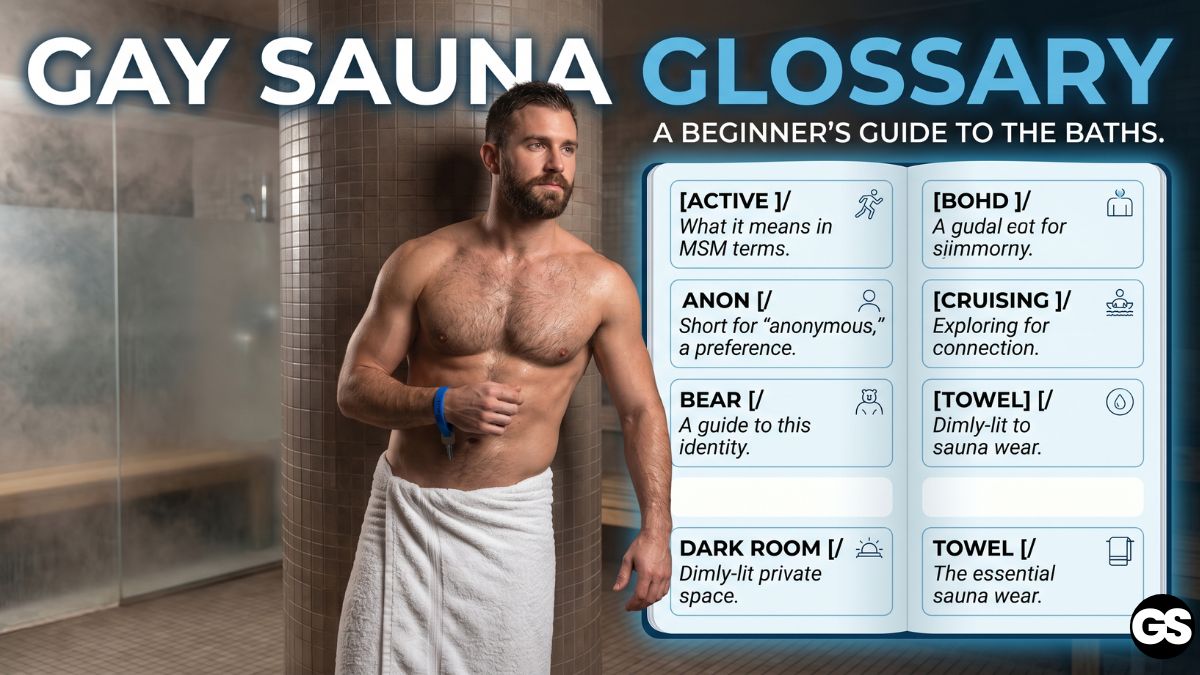
A handful of words come up over and over in any conversation about saunas, and most of them only make sense if you've been in one. None of them are difficult once they're explained. Here's the short version of each, in the phrasing you'd actually use out loud.
If a term sends you somewhere else on the site, the link is there — there's more on the rooms over on what's inside, and the cruising signals get a fuller treatment on the dos and don'ts page.
Rooms and spaces
These are the rooms you'll find in most UK saunas, give or take a wet/dry permutation. Layouts vary, but the names don't.
Dry sauna
The wood-lined room with the heater in the corner and the little bucket of water you ladle onto the rocks. Hot, not humid. Conversation drops to almost nothing once it pushes past 70 degrees.
Wet sauna
A loose term most places use for the steam room, or sometimes for any humid room in the building. If you hear "wet sauna" you're being told there's water involved — the rest is just where the heat is coming from.
Steam room
Tile or stone, a vent in the ceiling, visibility down to about a metre once it gets going. The heat sits lower than a dry sauna's and feels heavier on the chest. Most places run it hottest mid-evening.
Jacuzzi
The tub with the jets. Usually warm, occasionally hot, capacity for somewhere between four and eight depending on how British everyone's being about personal space.
Plunge pool
The cold one. Often deeper than it looks. The point is to climb in straight after a long sit in the steam room — the contrast is the whole experience, even if the first ten seconds feel like a punishment.
Cabin
A small private room with a door, a flat surface to lie on, and a lock. Some venues call them rooms, some call them booths, most call them cabins. Cabins are private rooms where men have sex — that's what they're for.
Darkroom
Exactly what it sounds like. Lights off or close to it, often a maze layout, and anything that happens in there happens between people who chose to be there. If you wander in and it's not for you, you wander back out — nobody is keeping score. The layout always loops back to the entrance, by design.
Dressing room
The room with the lockers, the benches, and the mirrors. Doubles as a place to gear up and a place where conversations start when people are heading out. Often busiest in the half-hour either side of opening.
Lounge or chill-out area
The clothed-or-towelled bit with sofas, a TV, often a snack counter. Where people land between rounds, dry off, scroll through whatever's playing on the screen, or just sit. A perfectly legitimate place to spend most of your visit.
Fixtures you'll spot in some venues
Two pieces of kit show up in some saunas and not others — worth knowing the words even if your venue doesn't have them. Bigger venues are likelier to have both; smaller ones often have neither.
Sling
A leather or rubber harness slung from chains, usually in its own small room or alcove. Most venues that have one keep it in a side area rather than the main floor. Plenty of saunas don't have one at all.
Glory hole
A hole at waist height in the wall between two cabins or stalls. The term is descriptive, not coded — it does what it sounds like. Use is entirely optional in either direction.
The cruising language
Almost all the communication on the floor is non-verbal, and these are the two words for it. They cover the looking and the answering — that's most of the vocabulary you'll need.
Cruising
The whole back-and-forth of looking, being looked at, walking past once, walking past again, eye contact that holds for a beat. It's what most of the floor traffic is, even when nothing visibly happens. Used as a verb too — "to cruise" — same meaning.
Signal
The small non-verbal cue that tells someone you're interested or available — a held look, a slight nod, an open cabin door, a hand left on the bench beside you. A closed cabin door, by contrast, means leave it alone. The vocabulary is small and you'll pick it up in your first hour.
Who you'll see
Two labels people use about themselves and each other — neither is a status thing. Both turn up in venue chatter and on forums often enough to be worth knowing.
Regular
Someone who comes in often enough that the staff and other regulars know them by face. Regulars aren't a clique — most of them are friendly to first-timers. They just move differently because they know the building.
First-timer
You, for the first visit. After that you're not, even if you only come once a year. Nobody can tell from looking, and nobody is checking.
Types of venue
Two ways UK saunas handle entry — the difference matters mostly for whether you can walk up on the day. Both models are common; the choice is usually a planning matter for the venue, not a vibe one.
Member club
A venue you have to join before you can get through the door. Some take memberships at reception on the day, some require an online sign-up first. The membership is a legal structure, not a status thing.
Walk-in
The opposite — a venue you can enter on the day with cash or card and no advance paperwork. Most UK saunas operate this way. Member-only places will say so on their website and at the door.
The very short version
Most of these words describe rooms or behaviours, not rules. The rooms are obvious once you've walked through them, and the behaviours sort themselves out within an hour.
Anything you don't recognise on a venue's site, the staff at the door will explain in one sentence.